The usage of dating apps and websites has seen a significant rise, with more than 323 million people who depend on dating app services for various reasons (Curry 2024). Despite this, about 55% of online daters have faced challenges, including IT security breaches, encountering misrepresentation, or facing rejection by potential matches. Experts estimate that by 2027, the dating sector will generate $28.36 billion in revenue, up from around $12.7 billion in 2021.
The explosion of digital courtship coincided with the popularity of smartphones. While Match and eHarmony established the foundation for online dating years ago, the trend gained momentum after the launch of the first iPhone in 2007 (Pamanian 2022). Subsequently, Grindr, Tinder, and Bumble emerged in 2009, 2012, and 2014, respectively, revolutionising online dating with features like location tracking, swiping, and advanced algorithms that attracted a wide audience.
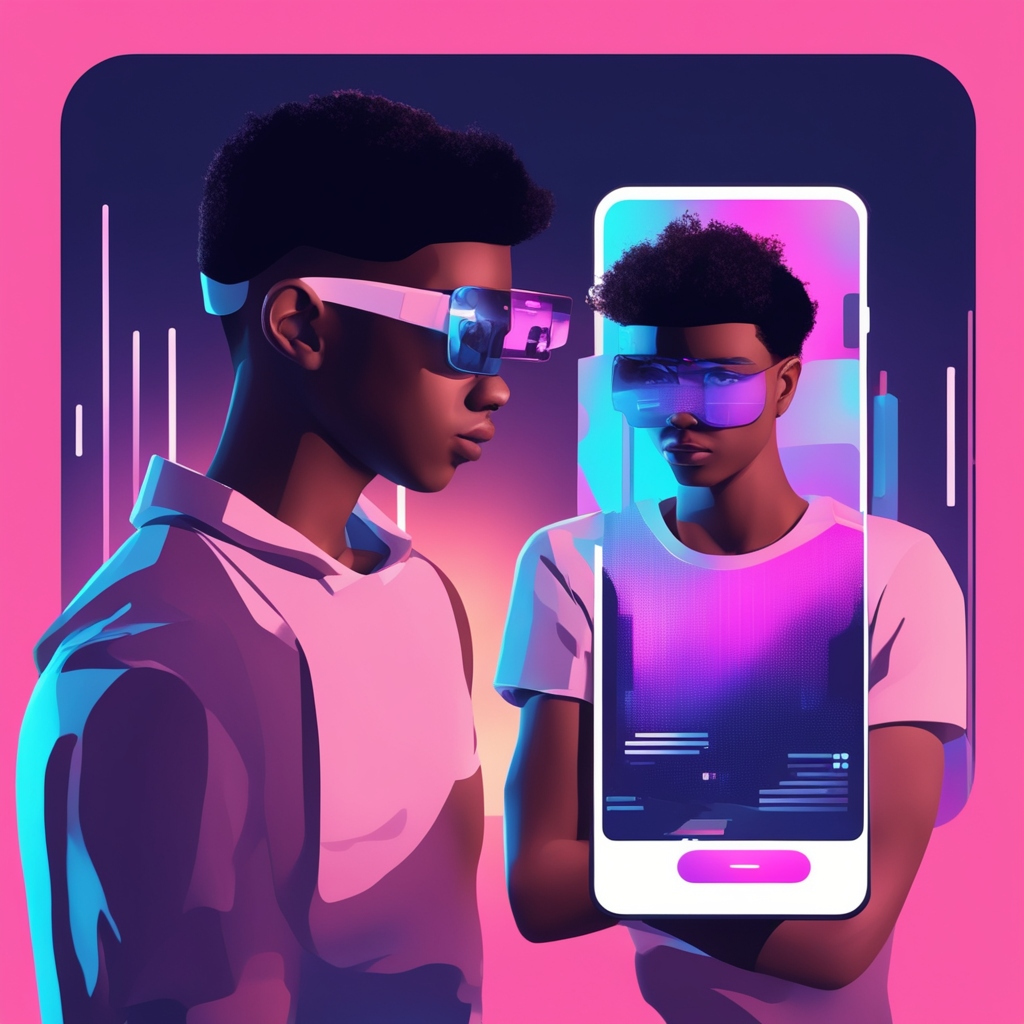

AI can be expanding its role in dating beyond writing bios on apps.
You can be as lazy as you sometimes may be, because the app writes the bio for you. One might use ChatGPT to compose breakup messages with a “friendly but firm” tone, softening the message while still conveying their reasons for ending things. AI is also used for flirty conversations and selecting attractive photos on dating apps like Tinder (Heilweil 2022; Romance scammer detector: the potential of AI in dating apps to fight fake profiles 2024). While this technology can be helpful in navigating uncomfortable tasks, there’s concern it may diminish emotional responsibilities and reduce human interactions in dating apps.
By the year 2031, half of all relationships are projected to begin online.
One major challenge faced by online dating platforms would be achieving the right balance between usability and security which might be tricky for dating apps development companies (Albury et al. 2017; Du & Xie 2021). As technology evolves rapidly, the future of online dating remains uncertain.
The focal point of AI market in the realm of virtual dating is whether matchmakers will be ready to tackle the issues of data culture while ethical and effective AI adaption in online dating experience is maintained (Albury et al. 2017; Ma et al. n.d.; Du & Xie 2021; Romance scammer detector: the potential of AI in dating apps to fight fake profiles 2024).
According to ChatGPT, these five technological advancements are likely to shape the future of online dating:
- Improved Matching Algorithms: By 2030, dating apps are expected to enhance their matchmaking algorithms, considering factors beyond superficial traits like age and location. These algorithms may focus on compatibility based on personality traits, values, life goals, genetic compatibility, and more.
- Virtual Reality Dating: Virtual activities and events such as speed dating or virtual games may be integrated into dating apps to facilitate more engaging connections. Augmented reality glasses could display compatibility scores and relationship status, enhancing virtual interactions.
- AI Dating Assistants: AI-powered dating assistants could become commonplace, analyzing user preferences and providing personalized advice and assistance in finding suitable matches.
- Enhanced Security Measures: Dating apps are likely to implement heightened security measures, including improved profile verification, background checks, and real-time monitoring to protect users from scams and fraudulent activities.
- Niche Dating Communities: Dating platforms may cater to specific niche communities based on shared interests, cultural backgrounds, or dietary preferences, allowing individuals to connect more deeply and find compatible partners beyond superficial interests.
However, as we look ahead, online dating companies face a new challenge. Hesam Hosseini, CEO of Match Group (which owns Match, Tinder, Hinge, OkCupid, and Plenty of Fish), expressed concerns about the quality of matches despite the high volume facilitated by these platforms (Beckman 2019).
The question now is how will they improve the quality of matches and ensure matchmakers are on a path to finding meaningful connections rather than just going on numerous dates.
Hosseini expressed difficulty in predicting chemistry, but he believes it’s achievable through technical effort (Beckman 2019). Dating apps are already making strides in this direction. For instance, Loveflutter, a UK-based dating app, employs AI to match individuals based on personality traits decoded from their tweets (Beckman 2019). Additionally, it plans to use AI to guide users through offline meetings after analysing their conversations.
A 2015 innovation AIMM, a voice-activated dating app with an AI matchmaker resemble Siri. It engages users in conversations for a week, providing personalised photo tours and audio snippets from matches.
Unlike traditional apps, AIMM skips tapping or swiping; instead, it arranges a phone call once mutual interest is confirmed, leaving the decision to meet offline to the users.
AIMM’s creator, Kevin Teman, emphasizes that AIMM strives to mimic human interactions, adapting to users’ preferences and values through subtle conversations.
Although AIMM’s potential for learning seems limitless, its promotional video is simply put, quite awkward.
In his article “Possible Futures” published in American Behavioral Scientist (1998, p.332), Bell discusses how the elements that enable social life play a crucial role in the welfare of all human communities. When we think about potential scenarios, we must also take into account the ethical consequences of those forecasts. Merely envisioning negative outcomes is insufficient; we must also assess the values and beliefs that align with a feasible future.
Possible Future of Dating in 2030:
In the possible future of dating in 2030, we can envision a wide range of scenarios driven by technological advancements, societal shifts, and cultural changes. One possibility is the widespread adoption of virtual reality (VR) dating platforms, where individuals can create lifelike avatars and engage in immersive virtual dates (Beckman 2019; Consagoustech 2023). These platforms may offer enhanced features like AI-driven matchmaking algorithms that consider deep-seated compatibility factors such as personality traits, values, and life goals. Furthermore, advancements in wearable technology might enable augmented reality (AR) dating experiences, where compatibility scores and relationship statuses are displayed in real-time, making it easier for individuals to connect with like-minded partners (Beckman 2019; Consagoustech 2023). Another possible development could be the rise of niche dating communities catering to specific interests, hobbies, or cultural backgrounds, allowing individuals to find meaningful connections based on shared values and beliefs.
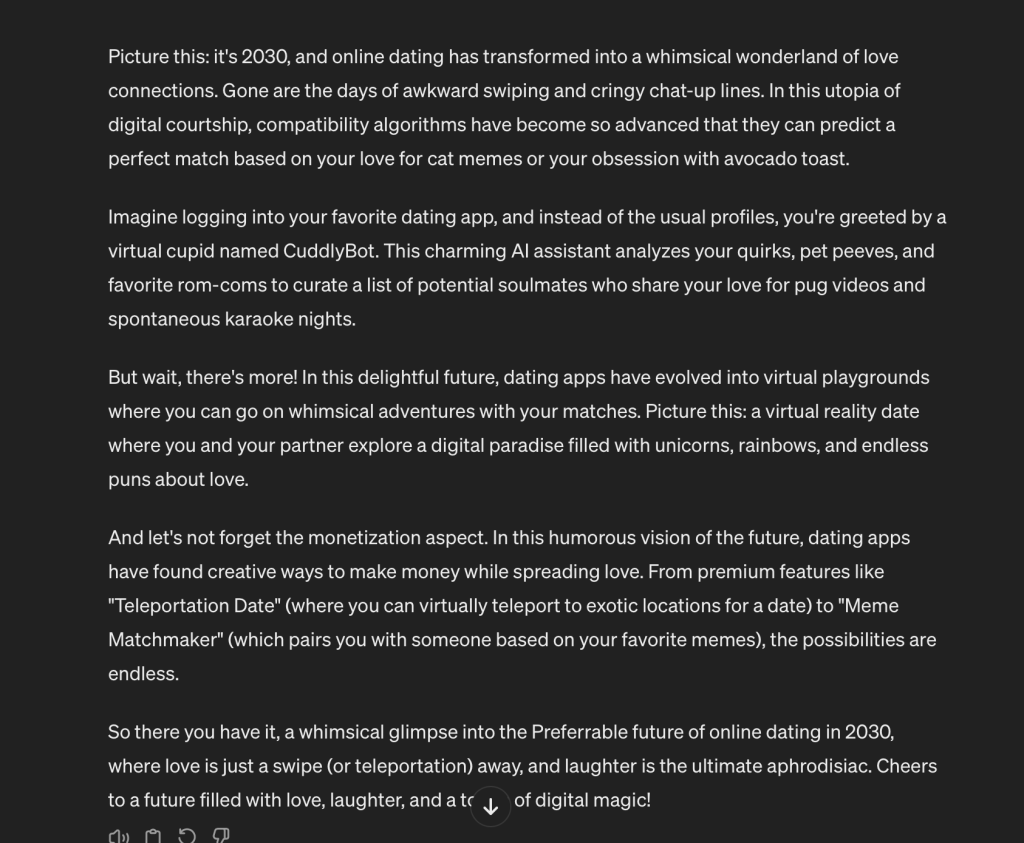
ChatGPT foresees that the possible future of the online dating industry in 2030 is closely tied to several key factors, including advanced features of dating apps, monetisation strategies, and personalisation efforts. Pragmatistic in the way that it touches on over-monetisation along with advanced digital marketing. Here’s why these aspects are pivotal for the industry’s potential evolution:
- The Wonders of Dating App Upgrades: Picture this: dating apps evolving into high-tech cupids with all the fancy upgrades. These cutting-edge features might include:
- Supercharged matchmaking algorithms: Thanks to AI and machine learning, dating platforms can now play matchmaker with pinpoint accuracy, analyzing preferences, behaviors, and compatibility factors for the perfect match.
- Virtual and augmented reality (VR/AR) escapades: Strap in for immersive virtual dates, events, or games that bring the fun of real-life interactions to your device. Who needs reality anyway?
- Fortified security and ID checks: In a world of online catfishing and cyber spooks, dating apps are stepping up their game with biometric authentication, identity verification, and real-time monitoring. Safety first!
- Cash Flow Fantasies: It’s all about the Benjamins for online dating platforms. To keep the love money train chugging along, dating apps are getting creative with moneymaking schemes such as:
- VIP subscriptions: Unlock exclusive features, ad-free bliss, and supercharged functionalities with premium subscription tiers. Who says love can’t be monetized?
- Splurge-worthy in-app purchases: Spruce up your profile with virtual gifts, boosts, or premium content, all just a purchase away. Because who doesn’t need a digital bouquet now and then?
- Ads and buddies: From sponsored posts to brand collaborations, dating apps are cashing in on advertising and partnerships, giving you love connections with a side of product placements.
- Tailored Tidbits: Let’s get personal! Dating apps are cranking up the customization for that special touch:
- Personalized picks: Get date recommendations, personalized content, or event ideas tailored to your unique preferences, all thanks to some sneaky data analysis and clever algorithms.
- Chatty chatbots: Say hello to AI-powered chat pals who dole out personalized advice, snazzy conversation starters, and the occasional virtual shoulder to lean on. Who knew bots could be so friendly?
- Shape-shifting interfaces: Dating interfaces are getting dynamic, bending and flexing to match your every whim, need, and communication style. Pretty cool, huh?


Probable Future of Dating in 2030:
The probable future of dating in 2030 is likely to see a continuation and evolution of current trends in online dating. AI-powered dating assistants may become more commonplace, assisting users in analysing preferences, chatting with potential matches, and providing personalised advice (Albury et al. 2017; Beckman 2019; Consagoustech 2023). Virtual dating activities and events, such as virtual speed dating or interactive games, could become standard features on dating platforms, enhancing user engagement and connection opportunities. Additionally, heightened security measures and identity verification processes are expected to be implemented to ensure a safer online dating environment, addressing concerns related to scams, catfishing, and privacy breaches (Albury et al. 2017; Ma et al. n.d.).


Preferable Future of Dating in 2030:
The preferable future of online dating in 2030 envisions a landscape where technology serves as a facilitator rather than a substitute for genuine human connections. Dating platforms would prioritize user well-being by promoting meaningful interactions, fostering genuine connections, and facilitating emotional compatibility. AI-driven matchmaking algorithms would focus not only on surface-level traits but also on deeper aspects of compatibility. Virtual and augmented reality technologies would be utilized to enhance communication and intimacy, allowing individuals to build stronger connections before meeting in person (Albury et al. 2017; Beckman 2019; Consagoustech 2023). Moreover, dating apps would emphasize inclusivity, diversity, and respect, creating a welcoming environment for users from all backgrounds and orientations. The preferable future of dating in 2030 envisions a landscape where technology enhances, rather than replaces, the human experience of love and relationships.

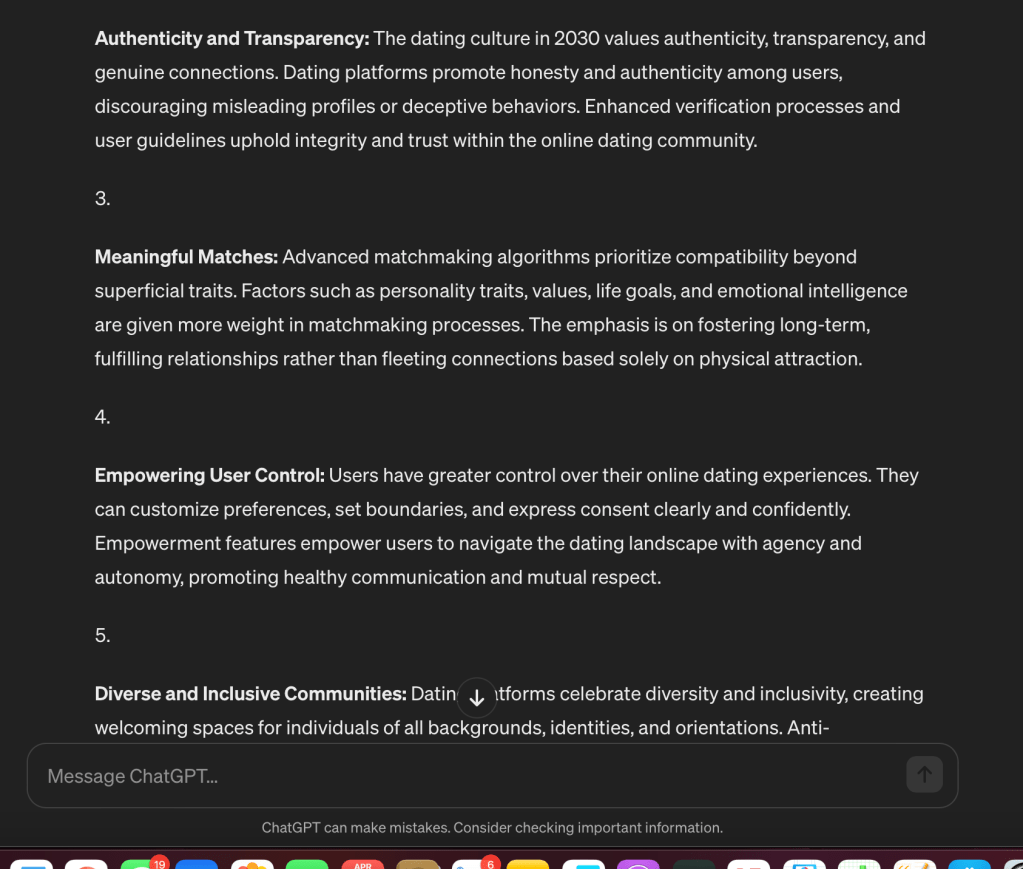

*DeepAI was used to generate images (Figure 1, 2, 3, 4, 7, 8) on this page. https://deepai.org/machine-learning-model/text2img
*I asked ChatGPI to produce answers in a humorous tone. The idea behind that is, even if the text-based AI provides undesired results due to insufficient prompts, it tries to project humour within the limited amount of information. The error in this context often shows what sort of information should have been given to the prompt and the way ChatGPT attempts to sound cheeky based upon the particular terminology or specific names sometimes gives me an epiphany.
Reference
Albury, K., Burgess, J., Light, B., Race, K., Wilken, R.: Data cultures of mobile dating and hook-up apps: emerging issues for critical social science research. Big Data Soc. 4, 1–11 (2017)
Beckman, L 2019, “What will online dating be like in 2030?”, Mashable, Available at: https://mashable.com/article/future-online-dating , Accessed 1 April, 2024.
Bell, Wendell. (2002). Making people responsible: The possible, the probable, and the preferable. In James A. Dator (Ed.), Advancing futures: Futures studies in higher education (pp.33-52). Westport, CT: Praeger
Bell, Wendell (2004). Foundations of futures studies: human science for a new era: values, objectivity, and the good society (Vol. 2). 1st Edition. Routledge. New York.
Consagoustech 2023, “What Will Be The State Of Online Dating In 2030?”, Medium, Available at: https://medium.com/@itsconsagous/what-will-be-the-state-of-online-dating-in-2030-a65e7b309b07#, Accessed 1 April, 2024.
Curry, D 2024, “Dating App Revenue and Usage Statistics (2024)”, Business of Apps, Available at: https://www.businessofapps.com/data/dating-app-market/, Accessed 1 April, 2024.
Daily Mail Australia 2014, “Half of new couples will meet on the internet by 2031 as relationships that start at school or work decline”, Daily mail, Available at: https://www.dailymail.co.uk/news/article-2544975/Half-new-couples-meet-online-20-years-time-according-new-research.html#:~:text=to%20new%20research-,More%20than%20half%20of%20all%20couples%20will%20meet%20online%20within,2031%2C%20according%20to%20the%20study., Accessed 1 April, 2024.
Du, S & Xie, C 2021, Paradoxes of artificial intelligence in consumer markets: ethical challenges and opportunities. J. Bus. Res. 129, 961–974.
Grand View Research 2022, “Online Dating Application Market Size, Share, & Trend Analysis by Revenue Generation Subscription, (Age (18 – 25 years, 26 – 34 years, 35 – 50 years, above 50 years), Gender, and Type) and by Region and Segment Forecasts, 2023 – 2030”, Grand View Research, Available at: https://www.grandviewresearch.com/industry-analysis/online-dating-application-market-report/toc, Accessed 1 April, 2024.
Heilweil, B.R 2022, “Tinder may not get you a date. It will get your data”, pp. 1–9 (2022)
Ma, Z, Chong, WK & Song, L n.d. “How Arousing Benefits and Ethical Misgivings Affect AI-Based Dating App Adoption: The Roles of Perceived Autonomy and Perceived Risks,” in Design, Operation and Evaluation of Mobile Communications, Springer International Publishing, Cham, pp. 160–170.
Matthews, H 2023, “27 Online Dating Statistics in 2024”, DatingNews.com, Available at: https://www.datingnews.com/industry-trends/online-dating-statistics-what-they-mean-for-future/, Accessed 1 April, 2024.
Kaspersky Daily 2024, “Dangerous Liaisons: is everyone doing it online?”, Available at: https://www.kaspersky.com/blog/online-dating-report/#:~:text=Overall%2C%2055%25%20of%20people%20that,at%20risk%20more%20than%20women., Accessed 1 April, 2024.
Pamanian, P 2022, “The evolution of online dating”, Daily Sundial, Available at: https://sundial.csun.edu/168529/arts-entertainment/the-evolution-of-online-dating/, Accessed 1 April, 2024.
Romance scammer detector: the potential of AI in dating apps to fight fake profiles 2024, English ed., ContentEngine LLC, a Florida limited liability company, Miami.
 It's Toi (Sorely Winter)
Leave a comment